
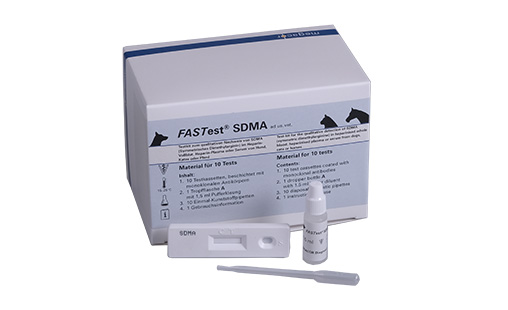
Description
Quantitative Detection Of SDMA
Test applicable to: Dogs, Cats & Horses
Sample: Heparinised whole blood, heparinised plasma, serum
Test time/duration: 10 minutes
Storage: Room temperature (15–25°C)
Test procedure: Rapid test
Symmetric dimethylarginine (SDMA)
Symmetric dimethylarginine (SDMA) is a reliable biomarker for assessing kidney function in animals. As a breakdown product of protein metabolism, 90% of it is excreted via the kidneys. An increase in SDMA indicates a decreasing glomerular filtration rate (GFR) and thus impaired kidney function. Unlike creatinine, SDMA is not influenced by muscle mass and also allows for significantly earlier detection of kidney dysfunction, even before typical symptoms such as loss of appetite, weight loss or polyuria/polydipsia occur.
Detection of increased SDMA
The current upper limit for dogs, cats and horses is 14 μg/dl (Hokamp and Nabity 2026, review, Siwinska et al., 2020). In certain breeds (e.g. Greyhounds, Liffmann et al., 2018) or in foals (Siwinska et al., 2020), higher values may be measured physiologically. Setting the cut-off at ≥ 14 μg/dl ensures that clinically significant elevations are reliably detected and that the test can be optimally used as a screening tool to rule out GFR impairment: whilst a negative result makes the presence of renal insufficiency highly unlikely, a positive result is considered an important warning sign of kidney disease. In such cases, further investigation – such as a precise laboratory determination of the SDMA value, a complete urinalysis or the measurement of the urine protein-to-creatinine ratio – is strongly recommended.
FASTest® SDMA
The FASTest® SDMA, as an early marker of GFR, enables vets to assess kidney health in dogs, cats and horses onsite. In the event of elevated values, a comprehensive diagnostic investigation of kidney function can thus be initiated in a targeted manner
FASTest SDMA Product Information Sheet
