
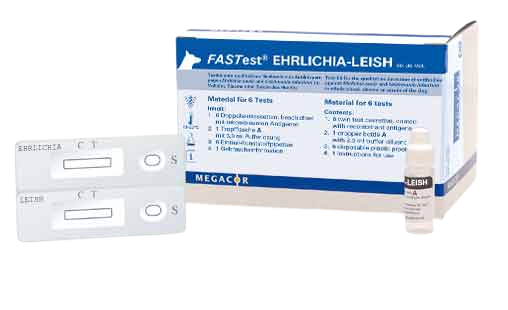
Description
Fast test for the detection of antibodies against Ehrlichia canis and Leishmania infantum in whole blood, plasma or serum of the dog
Test Applicable to: Dogs
Sample: Whole blood, plasma or serum
Leishmaniosis (Leishmania infantum) & Ehrlichiosis (CME, Ehrlichia canis) Vector-borne infectious diseases
Both the canine Leishmaniosis (Leishmania infantum) and the canine monocytic Ehrlichiosis (CME, Ehrlichia canis) count among the most important vector-transmitted infectious diseases / travel diseases of the dog. Coinfections play a major role, because these dogs are more likely to become ill. In the literature, there are hints that an upstream Ehrlichia infection possibly sensitizes for a Leishmania infection.
The seroprevalences for the Ehrlichiosis and Leishmaniosis vary strongly depending on country (endemic or non-endemic) and study. In addition, indigenous infections in dogs with symptoms of canine Leishmaniosis, but without a travel report, are increasingly being described in non-endemic areas (e.g. Germany).
The canine Ehrlichiosis is characterized by a very long incubation period (Ø 4–5 to 12–13 years) and a non-specific clinic and is therefore also referred to as “silent killer”!
Dogs with clinical Leishmaniosis show typical clinical symptoms and/or clinic-pathologic findings. Sub clinically infected dogs (infected, but clinically healthy) do not show any symptoms during clinical examination and no clinical-pathologic findings.
The consequences of such coinfection from an immunological, therapeutic and diagnostic point of view are known to very few veterinarians. Therefore, FASTest® EHRLICHIA-LEISH is useful as rapid qualitative antibody detection test in dogs suspected of having leishmaniosis, ehrlichiosis or a coinfection.
