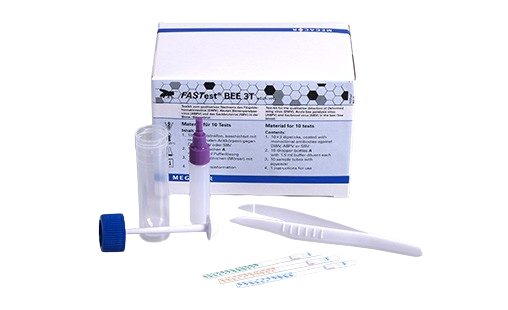
FASTest BEE Range
Rapid, Onsite Test Range for the Qualitative Detection of Deformed Wing Virus (DWV), Acute Bee Paralysis Virus (ABPV) and Sacbrood Virus (SBV) in the Honeybee. Tests now also available for BQCV (Black Queen Virus) & AFB (American Foulbrood)
Description
FASTest® BEE Range
Protecting your bee colonies is now even easier! We are delighted to introduce the new FASTest® BEE BQCV Strip and the new FASTest® BEE AFB.
Bringing our range of mobile bee diagnostic tools to four specialised rapid tests:
–FASTest® BEE 3T — Detection of DWV, ABPV and SBV (deformed wing virus, acute bee paralysis virus and sacbrood virus)
FASTest Bee 3T Product Information
– FASTest® BEE DWV Strip — Detection of DWV (deformed wing virus)
FASTest BEE DWV Product Information
– FASTest® BEE BQCV Strip — Detection of the black queen cell virus
FASTest BEE BQCV Product Information
– FASTest® BEE AFB — Detection of Paenibacillus larvae, the causative agent of American foulbrood
FASTest BEE AFB Product Information
No long wait for laboratory results. You receive an accurate result on site in just 10 to 15 minutes. Saving you valuable time for the treatment of diseased bee colonies.
FASTEST BEE 3T
Qualitative detection of Deformed wing virus (DWV), Acute bee paralysis virus (ABPV) and Sacbrood virus (SBV) in the honeybee.
Test applicable to: Honeybees
Sample Material: Bee
Honeybees (Apis mellifera) are now considered to be an essential part of agriculture world-wide due to providing a highly valued pollination service for a wide variety of agricultural crops and are the most frequent single species of pollinator for crops worldwide.
This important ecosystem service is essential for sustainable & productive agriculture and for the maintenance of the non-agricultural ecosystem. Therefore, monitoring the health and vitality of honeybee colonies plays a crucial role. Besides numerous parasites and fungi (e.g., Varroa destructor and Nosema spp.), viruses (e.g., Deformed wing virus DWV, Acute bee paralysis virus ABPV, Sacbrood virus SBV) pose a great threat to the health and welfare of honeybees.
DWV (Deformed wing virus)
DWV (Deformed wing virus) that is triggered by stress (heavy parasite infestation (Varroa destructor), lack of food and incorrect beekeeping management), can cause characteristic disease symptoms (shrunken, flightless wings, reduced body size & discolouration in adult bees).
SBV (Sacbrood virus)
SBV (Sacbrood virus) Sacbrood is a condition affecting the brood of the honeybee which causes significant morphological changes resulting in larval death. Larvae with sacbrood fail to pupate, and ecdysial fluid, rich in sacbrood virus (SBV), accumulates beneath their unshed skin, forming the sac for which the condition is named. Infected larvae change in colour from pearly white to pale yellow, and shortly after death they dry out, forming a dark brown gondola-shaped scale. Adult bees develop an infection without visible disease signs, characterized only by a reduced lifespan. Sacbrood occurs most frequently in spring, when the colony is growing most rapidly and there are a large number of susceptible larvae and young adults.
ABPV (Acute bee paralysis virus)
ABPV (Acute bee paralysis virus) multiplies mainly in the pupae. Triggered by mite infestation, bacterial infections, environmental pollution, chemicals, insecticides, etc, the infection is characterized by rapidly progressing paralysis, trembling, inability to fly, gradual darkening and loss of hair from the chest and abdomen and rapid death in adult bees.
Numerous studies indicate that there is a reciprocal relationship between the infestation level of Varroa destructor (parasitic mite Varroa) and certain viral diseases (especially DWV, ABPV, SBV). The Varroa mite serves as a virus reservoir and carrier of these viruses. This fatal combination is considered the main cause of winter losses. DWV indicates a significant correlation between the level of Varroa infestation and the virus load.
FASTest® BEE 3T
FASTest® BEE 3T is a quick and easy diagnostic tool for the beekeeper for the detection and containment of these viruses.
In the case of a positive result, prophylactic measures (e.g., Varroa control) can be initiated immediately.
Symptoms:
DWV
- Shrunken/Deformed Wings
- Reduced Body Size
- Discolouration
SBV
- Morphological Changes
- Larval Death
- Failure to Pupate
- Sac Forming Fluid Accumulation
- Larvae Discolouration.
ABPV
- Rapidly Progressing Paralysis, Trembling, Inability to Fly, Gradual Darkening and Loss of Hair from the Chest and Abdomen
- Rapid death in adult bees
FASTest BEE BQCV
FASTest® BEE BQCV Strip is a rapid immunochromatographic assay for the qualitative detection of black queen cell virus (BQCV) in the bee maggot/bee pupa.
Test applicable to: Honeybees
Honeybees
Honeybees (Apis mellifera) are among the top 3 agricultural livestock world-wide by pollinating a wide range of crops and ornamental plants. This important ecosystem service is essential for sustainable, productive agriculture and for the maintenance of the non-agricultural ecosystem. Therefore, monitoring the health and vitality of honeybee colonies plays a crucial role.
Threats to honey bees
One of the greatest threats to honey bees is viral infections, as these can be significantly linked to colony losses. In particular, the sacbrood virus SBV, the deformed wing virus DWV, the black queen cell virus BQCV and the acute bee paralysis virus ABPV are associated with the death of individual bees and the collapse of individual colonies. Early detection of virus outbreaks could help reduce colony losses and prevent the spread of disease. The availability of specific rapid tests can greatly simplify and speed up virus diagnosis.
The black queen cell virus (BQCV)
The black queen cell virus (BQCV) is an RNA virus (order picornavirales). Despite its widespread distribution, symptoms are rarely reported. It can therefore be assumed that this virus primarily occurs as a hidden infection without symptoms. If infection occurs, it mainly affects queen maggots and pupae, which die and decompose as a result of the infection. During this process, the queen cell turns black, hence the name. Interestingly, adult bees can also become ill and die if they are artifi cially injected with BQCV. This is taken as an indication that BQCV can also be dangerous to adult bees if it is transmitted to other bees.
BQCV diagnosis
BQCV diagnosis in honey bees is currently only possible using reverse transcriptase polymerase chain reaction (RT-PCR) and real-time PCR, both of which are expensive and time-consuming laboratory procedures.
FASTest® BEE BQCV
With the FASTest® BEE BQCV Strip, beekeepers can now detect BQCV easily, cost-effectively and directly at the hive.
FASTest BEE DWV
Fast test for the qualitative onsite detection of Deformed wing virus (DWV type A and B), in the bee / bee brood
Test applicable to: Honeybees
Sample Material: Bee
Honeybees
Honeybees (Apis mellifera) are among the top 3 agricultural livestock world-wide by pollinating a wide range of crops and ornamental plants. This important ecosystem service is essential for sustainable, productive agriculture and for the maintenance of the non-agricultural ecosystem. Therefore, monitoring the health and vitality of honeybee colonies plays a crucial role. Besides numerous parasites and fungi (e. g. Varroa destructor and Nosema spp.), viruses (e. g., deformed wing virus DWV, acute bee paralysis virus ABPV, sacbrood virus SBV) pose a great threat to the health and welfare of honeybees.
DWV
DWV (genotype A and B) is considered the most important representative of Varroa-associated viruses, is closely linked to winter mortality and is spread world-wide. Genotype B appears to be particularly well adapted to Varroa: the mite is not only considered a mechanical vector, but also forms a reservoir for the reproduction of DWV-B3.
Triggers & Symptoms
DWV, triggered by stress (heavy infestation with V. destructor, lack of food, incorrect colony management), can cause characteristic disease symptoms (shrunken, flightless wings, reduced body size, discoloration in adult bees, incomplete brood nests, dead pupae).
The Varroa mite
Numerous studies indicate that there is a mutual relationship between the infestation level of V. destructor (parasitic mite Varroa) and certain viral diseases (especially DWV, ABPV, SBV). The Varroa mite serves as a virus reservoir and carrier of these viruses. This fatal combination is considered the main cause of winter losses! DWV shows the best correlation between the level of Varroa infestation and the virus load.
Diagnosis & Treatment
For the assessment and containment of these winter losses, the direct virus detection on-site using FASTest® BEE DWV Strip is a quick and easy diagnostic tool for the beekeeper. In the positive case, regardless of which virus test is positive, the Varroa control strategy (Varroa status) of the hive should be reviewed according to the guidelines of the respective country.
FASTest BEE AFB
Fast test for the qualitative detection of Paenibacillus larvae genotypes ERIC* I and ERIC II in bee colonies
Test applicable to: Honeybees
Honeybees
Honeybees (Apis mellifera) are among the top 3 agricultural livestock world-wide by pollinating a wide range of crops and ornamental plants. This important ecosystem service is essential for sustainable, productive agriculture and for the maintenance of the non-agricultural ecosystem. Therefore, monitoring the health and vitality of honeybee colonies plays a crucial role.
The American Foulbrood (AFB)
The American Foulbrood (AFB) is a severe bee disease in honey bees and is caused by the spore forming, rod-shaped and gram-positive bacterium Paenibacillus larvae. Only young larvae are susceptible for the infection by ingestion of spores. Adult bees are immune, but act as carriers. If dead larvae are not removed quickly enough by nurse bees, their tissue dries out in the capped brood cell to form a black scab containing up to 2.5 billion spores, which are highly infectious to other larvae. This allows the infection to spread very quickly to the entire brood of a bee colony, leading to a massive weakening or even the death of the entire colony.
Paenibacillus larvae
Paenibacillus larvae mainly occurs in two potent genotypes, ERIC I and ERIC II. These genotypes differ in their degree of lethality (ERIC I approx. 12 days, ERIC II approx. 7 days to 100% lethality). Due to its high virulence and rapid lethality, AFB is classified as a notifiable animal disease in the European Union (Regulation 2016/429 and Implementing Regulation (EU) 2018/1882).
FASTest® BEE AFB
With the FASTest® BEE AFB, Paenibacillus larvae can be detected easily, cost-effectively and directly on-site at the beehive by the beekeeper.
* ERIC = Enterobacterial Repetitive Intergenic Consensus
Advantages
- Rapid Test Results: 10–15 minutes
- Easy to perform
- Simple & hygienic
- Long Shelf Life
- Storage at Room temperature (15–25 °C)